
How to Become a Java Full Stack Developer After Graduation (2026 Guide)
By Elearn Infotech Career Guidance Team, with input from our Java Full Stack trainer · Updated
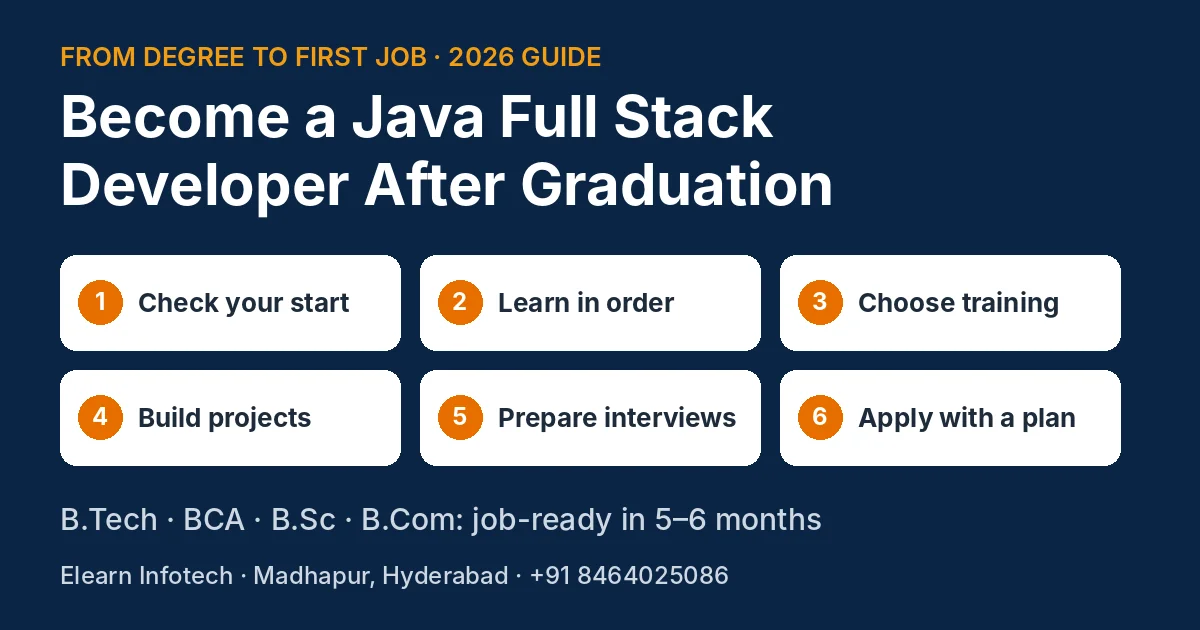
Quick answer: After graduation, you can become a Java Full Stack Developer in about 5–6 months by following six steps: check your starting point, learn the skills in the right order (Core Java, SQL, Spring Boot, React JS), choose practical training with a trainer, build 5–6 projects on GitHub, prepare for interviews, and apply with a clear plan. Your degree matters less than your skills and projects. Graduates from B.Tech, BCA, B.Sc and even B.Com have made this switch.
You have your degree certificate. Now what? Many graduates feel stuck at this point, especially if college didn't teach practical coding or if their degree isn't in computer science. The good news: companies hiring Java Full Stack Developers mostly test what you can build, not where you studied. This guide walks you through the path from graduation day to your first developer job.
Can Any Graduate Become a Java Full Stack Developer?
Yes, but your starting point decides how much extra effort you need.
| Your degree | Where you start | What to focus on |
|---|---|---|
| B.Tech CSE / IT, MCA | You may know some Java and SQL from college | Refresh Core Java, then move quickly to Spring Boot, React and projects |
| BCA, B.Sc Computers | Basic programming knowledge | Strengthen OOP and SQL before frameworks |
| B.Tech ECE, EEE, Mech, Civil | Logical thinking, little coding | Spend extra time on Core Java and daily coding practice |
| B.Com, BBA, BA, B.Sc (non-CS) | Starting from zero | Go slowly through the basics, practise every day and lean on your trainer |
A Java Full Stack course for non-IT students is not a shortcut, but it gives you a clear path and someone to ask when you get stuck.
Step 1: Check Your Starting Point
Before you start, answer three questions honestly:
- Can I write a simple Java program with loops and conditions?
- Do I understand classes and objects?
- Can I write a basic SQL query?
If the answer to all three is "no", don't worry. Most graduates start here. It simply means your first month should focus on Core Java basics, not frameworks.
Step 2: Learn the Skills in the Right Order
Learning in the wrong order is the biggest time-waster. Follow this sequence:
- Core Java: OOP, collections, exception handling, Java 8 features
- SQL and MySQL: queries, joins, table design
- JDBC, Servlets, JSP, Hibernate: how Java connects to databases and the web
- Spring and Spring Boot: REST APIs, Spring Data JPA, Spring Security basics
- Front end: HTML, CSS, JavaScript and React JS
- Extras: Git, microservices, Docker, DSA and AI tools
For the full breakdown with time for each step, read our Java Full Stack Developer Roadmap 2026.
Step 3: Choose How You Will Learn
You have three options for Java Full Stack developer training. Pick the one that matches your discipline and situation.
| Option | Good for | Watch out for |
|---|---|---|
| Self-study (free videos) | Very disciplined learners with time | No doubt clearing, easy to skip topics, often no real projects |
| Java Full Stack classroom training | Graduates who want a fixed routine and face-to-face help | Needs daily travel to the institute |
| Java Full Stack online training (live) | Learners outside the city or with other commitments | Needs self-discipline at home; avoid recorded-only courses |
Whichever you choose, make sure your Java Full Stack development training is practical training. You should be writing code in every class, not just watching slides.
Step 4: Build Projects and Put Them on GitHub
For a fresher, projects are your work experience. Aim for 5–6 complete projects that each use Spring Boot, a database and a React front end, for example an employee management system, an e-commerce cart or an appointment booking app.
Push every project to GitHub with a short README: what the app does, which technologies you used and screenshots. Recruiters often check these links.
Step 5: Prepare for Interviews
Most Java Full Stack fresher interviews cover the same areas:
- Core Java: OOP concepts, collections, exceptions, strings
- SQL: writing queries with joins and GROUP BY
- Spring Boot: how REST APIs work, annotations, dependency injection
- DSA: simple coding problems on arrays and strings
- Your projects: what you built, why, and what was difficult
Practise explaining your projects out loud. Many graduates know the answer but struggle to say it clearly.
Step 6: Apply with a Plan
Don't just send your resume everywhere. Make a simple plan:
- Search for roles such as Java Developer, Full Stack Developer, Junior Software Engineer and Spring Boot Developer.
- Keep a one-page resume with your skills, projects and GitHub link at the top.
- Apply on job portals and LinkedIn, and ask for referrals from friends and seniors.
- Use your institute's placement assistance for mock interviews and job referrals.
- Track every application in a simple sheet and follow up.
A Realistic Timeline After Graduation
| Month | Focus |
|---|---|
| Month 1–2 | Core Java, SQL and MySQL |
| Month 3 | JDBC, Servlets, JSP, Hibernate, start Spring |
| Month 4 | Spring Boot, REST APIs, Spring Security basics |
| Month 5 | HTML, CSS, JavaScript, React JS, full stack projects |
| Month 6 | Microservices basics, DSA practice, resume, mock interviews, applying |
Graduates who already know Java from college often finish faster. Those starting from zero may need a few extra weeks of practice, and that is fine.
Real Student Story
Saketh Kumar graduated with a B.Com degree, far from computer science. He joined our Java Full Stack course and is now working as a Full Stack Developer. His story shows that a commerce degree does not stop you from becoming a developer.
What to Look for in a Java Full Stack Course
Before you pay for any Java Full Stack programming course, check these points:
- Up-to-date syllabus: Spring Boot, React JS, microservices and AI tools, not just old Java topics.
- A Java Full Stack course with projects: ask how many complete projects you will build and see examples.
- Trainer experience: ask who will teach you and where they have worked.
- Placement support in writing: resume help, mock interviews and referrals.
- Certificate: a Java Full Stack certification course should give you a course completion certificate, but remember that projects matter more than certificates in interviews.
- Free demo class: attend one before you decide.
Common Worries Graduates Have
"I have a gap after graduation." Many graduates start after a gap. Recent skills and real projects give you something strong to talk about in interviews.
"My percentage is low." Some large companies have cut-offs, but many companies care more about your skills, projects and interview performance.
"I'm from a non-IT background." Expect the first month to feel slow. That's normal. Daily practice closes the gap faster than you think, as Saketh's story shows.
Java Full Stack Course in Hyderabad at Elearn Infotech

If you want guidance at every step, our Java Full Stack Developer course in Hyderabad offers job-oriented Java Full Stack training. It works as a Java Full Stack course for beginners and for graduates, including non-IT students and freshers.
"Master Java with strong programming fundamentals and develop the skills to build robust, scalable applications."
– Mr. Raju, Full Stack Java Developer (15+ years, top MNCs), Java Full Stack trainer at Elearn Infotech
- Duration and fee: 5–6 months, ₹30,000
- Syllabus: Core Java to Spring Boot, React JS, microservices, Kafka, Docker, AWS basics, DSA and Gen AI tools
- Projects: 6 real-time projects
- Trainer: Mr. Raju, Full Stack Java Developer with 15+ years of experience at top MNCs
- Mode: classroom training at our Java Full Stack institute in Madhapur, near Hitech City, or live online
- Placement: Java Full Stack placement assistance in Hyderabad, including resume preparation, mock interviews and referrals
Students join our Java Full Stack training in Hyderabad from Gachibowli, Kondapur, Kukatpally, KPHB, Ameerpet and Secunderabad. Still deciding between stacks? Read Python Full Stack vs Java Full Stack vs MERN.
Frequently Asked Questions
How can I become a Java Full Stack Developer after graduation?
Check your starting point, learn Core Java, SQL, Spring Boot and React JS in that order, choose practical training with a trainer, build 5–6 projects on GitHub, prepare for interviews and apply with a plan. Most graduates can become job-ready in about 5–6 months.
Can a B.Com or non-IT graduate become a Java Full Stack Developer?
Yes. Non-IT graduates start from the basics and need extra practice in the first month, but with daily coding and a trainer to guide them, they can become developers. Our student Saketh Kumar, a B.Com graduate, is now working as a Full Stack Developer.
How long does it take to become a Java Full Stack Developer after graduation?
With a structured course and daily practice, most graduates become job-ready in 5–6 months. Graduates who already know Java from college may finish faster.
Is a Java Full Stack course good for freshers and beginners?
Yes. A good Java Full Stack course for freshers starts from Core Java basics and builds up to Spring Boot, React JS and real projects, so beginners can follow it step by step.
Is Java Full Stack online training as good as classroom training?
Live online training can be as effective as classroom training if it is instructor-led, includes projects and lets you clear doubts in real time. Classroom training suits learners who prefer a fixed routine and face-to-face help.
Does a Java Full Stack certification help in getting a job?
A course completion certificate shows you finished structured training, but interviewers focus more on your skills and projects. Use the certificate along with a strong GitHub portfolio.
What do Java Full Stack fresher interviews ask?
Most interviews cover Core Java OOP concepts, collections, SQL queries, Spring Boot and REST APIs, simple DSA problems and questions about your own projects.
What is the Java Full Stack course fee in Hyderabad at Elearn Infotech?
The Java Full Stack Developer course at Elearn Infotech, Madhapur is ₹30,000 for 5–6 months, with 6 real-time projects and placement assistance, in classroom and live online modes. It is taught by Mr. Raju, a Full Stack Java Developer with 15+ years of experience at top MNCs.
Related: Java Full Stack Developer Roadmap 2026 · What Is Full Stack Java Development? · Which Software Course Should a Fresher Choose in 2026?
Note & About this Guide
This guide was written by the Elearn Infotech career guidance team in Madhapur, Hyderabad, based on the questions graduates ask us at counselling and how our Java Full Stack trainer guides freshers. Course fees, durations and project counts are correct as of November 2026; please call us for the latest batch details.