
Data Analyst vs Data Scientist: Which Career Should You Choose in 2026?
By Elearn Infotech Career Guidance Team, with input from our data trainers · Updated
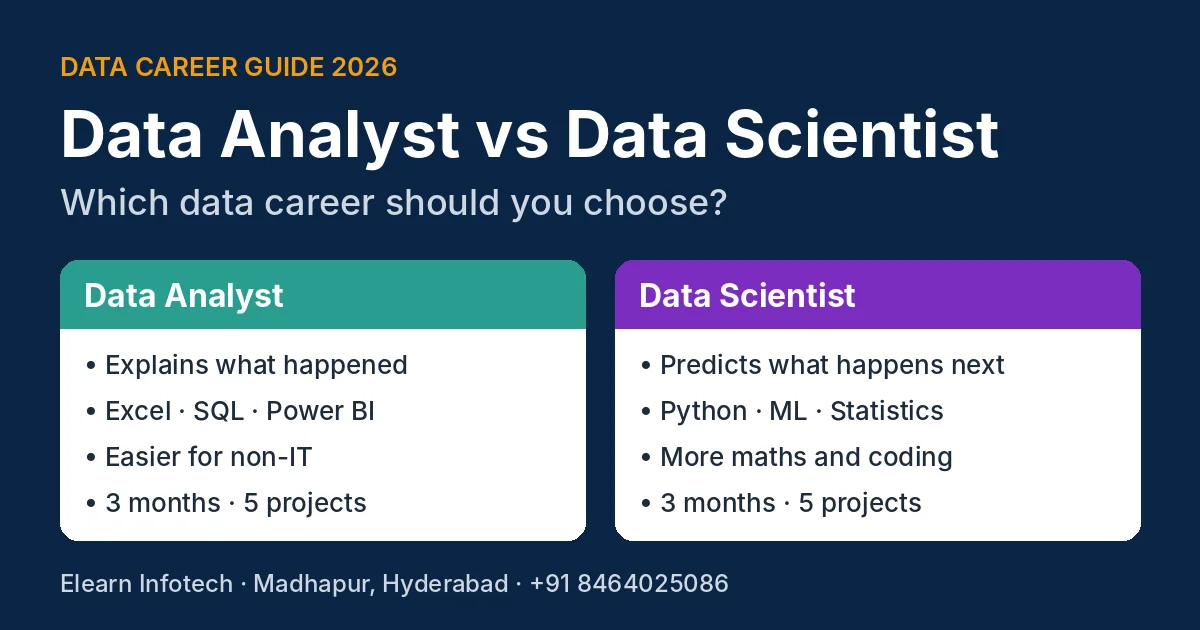
Quick answer: A Data Analyst looks at past data to explain what happened, using Excel, SQL, Power BI and Python. A Data Scientist builds models to predict what will happen next, using Python, statistics and machine learning. Data Analytics is easier to start and suits freshers and non-IT graduates. Data Science needs more maths and coding. If you are unsure, start as a Data Analyst. Many Data Scientists began that way.
"Should I become a Data Analyst or a Data Scientist?" is a question we hear often at our counselling desk. Both jobs work with data, both pay well, and the course names sound similar. But the day-to-day work is quite different. This guide explains the difference in plain words, so you can pick the one that fits you.
The Simple Difference
Think of a supermarket chain.
- The Data Analyst answers: "Which products sold the most last month, and in which stores?" They clean the sales data, find patterns and build a dashboard the manager can read in two minutes.
- The Data Scientist answers: "How much milk will each store need next week?" They build a machine learning model that learns from past sales and predicts future demand.
In short: analysts explain the past and present, scientists predict the future.
"A Data Analyst explains what happened through data, while a Data Scientist predicts what could happen next — both turn data into decisions."
– Mr. Sagar, Data Scientist (8+ years, MNCs), Data Analytics and AI & Machine Learning trainer at Elearn Infotech
Side-by-Side Comparison
| Data Analyst | Data Scientist | |
|---|---|---|
| Main question | What happened, and why? | What will happen next? |
| Daily work | Cleaning data, writing SQL queries, building reports and dashboards | Preparing data, building and testing machine learning models |
| Main tools | Excel, SQL, Power BI, Tableau, Python | Python, Pandas, NumPy, Scikit-learn, TensorFlow, SQL |
| Maths needed | Basic statistics | Statistics, probability and some linear algebra |
| Coding level | Low to medium | Medium to high |
| Easier for non-IT? | Yes | Possible, but harder |
| Typical fresher roles | Data Analyst, MIS Analyst, Business Analyst, Power BI Developer | Junior Data Scientist, ML Engineer (junior), Data Analyst |
| Elearn Infotech course | Data Analytics: 3 months, ₹25,000, 5 projects | Data Science: 3 months, ₹35,000, 5 projects |
Fees are for Elearn Infotech, Madhapur, and are the same for classroom and live online training. Both courses include placement assistance.
What Does a Data Analyst Do All Day?
A typical day might look like this:
- Pull last week's sales or customer data from a database using SQL.
- Clean it in Excel or Python: remove duplicates, fix missing values.
- Find patterns: which region dropped, which product grew.
- Update a Power BI or Tableau dashboard for the team.
- Explain the findings to a manager in simple language.
That last step matters more than most freshers expect. A good analyst is part data person, part storyteller.
Choose Data Analytics if:
- You like Excel, numbers and finding "why" behind a result.
- You come from B.Com, BBA, BSc, B.Tech or any degree, IT or non-IT.
- You want to get job-ready in about 3 months without heavy coding.
Student story: Kranthi. Kranthi, a B.Tech graduate, joined our Data Analytics course and is now working as a Data Analyst.
What Does a Data Scientist Do All Day?
A Data Scientist spends much of the day on models:
- Collect and prepare large datasets with Python.
- Explore the data to choose useful features.
- Train machine learning models, for example to predict customer churn or detect fraud.
- Test how accurate the model is and improve it.
- Work with developers to put the model into a real product.
Many Data Science roles now also involve Generative AI and large language models (LLMs), which our Data Science course covers.
Choose Data Science if:
- You enjoy maths, statistics and logic puzzles.
- You are comfortable with coding, or ready to practise it daily.
- You want to work on prediction, machine learning and AI projects.
Skills You Will Learn in Each Course
Data Analytics course
- Excel for data analysis
- SQL for databases
- Power BI and Tableau dashboards
- Python for data analysis
- Basic statistics
- 5 real-time projects
Data Science course
- Python, Pandas and NumPy
- Statistics and SQL
- Machine learning with Scikit-learn
- Deep learning and NLP basics
- Generative AI and LLMs
- 5 real-time projects
See the full syllabus on the Data Analytics course and Data Science course pages.
Can a Data Analyst Become a Data Scientist Later?
Yes, and it is a common path. Analysts already know SQL, Python basics and how businesses use data. After a year or two of work, adding machine learning and statistics is a natural next step. Starting as an analyst also lets you earn while you learn, instead of waiting until you master every topic.
If you already know Python and want to focus only on machine learning, our 2-month AI and Machine Learning course is a shorter option.
Which Is Better for Non-IT Freshers?
For most non-IT freshers, Data Analytics is the better first step. The tools are easier to learn, Excel is familiar to many, and the work is closer to everyday business problems. Data Science is possible for non-IT graduates too, but expect to spend extra time on Python and maths.
Will AI Replace Data Analysts?
This is a fair worry. AI tools can now write SQL queries and create charts. But someone still needs to ask the right question, check whether the data is correct and explain what the result means for the business. Analysts who use AI tools to work faster will be in demand. The ones at risk are those who only know how to click buttons, without understanding the data.
Quick Decision Guide
| If this sounds like you… | Choose |
|---|---|
| "I like Excel and finding patterns in numbers." | Data Analytics |
| "I'm from a non-IT background." | Data Analytics |
| "I want a job quickly with less coding." | Data Analytics |
| "I enjoy maths and want to build prediction models." | Data Science |
| "I'm interested in AI and machine learning." | Data Science |
| "I already know Python well." | Data Science or AI & Machine Learning |
Where Elearn Infotech Fits

Elearn Infotech in Madhapur, near Hitech City, offers both courses in classroom and live online modes. The Data Analytics course is taught by Mr. Sagar, a Data Scientist with 8+ years of experience at MNCs, and our Data Science trainers also have 8+ years of industry experience. Both courses include 5 real-time projects and placement assistance. Students join from Gachibowli, Kondapur, Kukatpally, KPHB, Ameerpet and Secunderabad.
Still deciding? Call or WhatsApp +91 8464025086 for free counselling, or book a free demo class for both courses.
Frequently Asked Questions
What is the difference between a Data Analyst and a Data Scientist?
A Data Analyst studies past data to explain what happened, using Excel, SQL, Power BI and Python. A Data Scientist builds machine learning models to predict what will happen next, using Python, statistics and machine learning. Analysts explain; scientists predict.
Which is easier: Data Analytics or Data Science?
Data Analytics is easier to start. It needs basic statistics and light coding with Excel, SQL, Power BI and Python. Data Science needs stronger maths and more Python coding for machine learning.
Can a non-IT graduate become a Data Analyst?
Yes. Many Data Analysts come from B.Com, BBA, BSc and other non-IT degrees. Excel, SQL and Power BI can be learned from the basics, and business knowledge is an advantage in this role.
Can a Data Analyst become a Data Scientist?
Yes. It is a common career path. Analysts already know SQL, Python basics and business data, so adding statistics and machine learning after some work experience is a natural next step.
Do I need coding for Data Analytics?
Only a little. Most analyst work uses Excel, SQL and Power BI. Basic Python helps with larger datasets and is included in the Data Analytics course.
Do I need maths for Data Science?
Yes, some. You need statistics, probability and basic linear algebra to understand how machine learning models work. A good course teaches the maths you need along the way.
What is the fee and duration of the Data Analytics and Data Science courses at Elearn Infotech?
The Data Analytics course is ₹25,000 for 3 months and the Data Science course is ₹35,000 for 3 months. Both include 5 real-time projects and placement assistance, in classroom and live online modes.
Will AI replace Data Analysts?
AI tools can write queries and draw charts, but companies still need people who ask the right questions, check the data and explain what results mean for the business. Analysts who use AI tools well will stay in demand.
Related: Which Software Course Should a Fresher Choose in 2026? · Python Full Stack vs Java Full Stack vs MERN
Note & About this Guide
This guide was written by the Elearn Infotech career guidance team in Madhapur, Hyderabad, based on the questions freshers ask us before choosing a data course, with input from our data trainers. Course fees, durations and project counts are correct as of November 2026; please call us for the latest batch details.